KC7Cyber Scholomance writeup
Question 1
Oh no! You’ve been hit by something, someone, or some force that has stolen something from your enclave. You’re not sure, but you need to investigate. There was a lot of emails going around about regulation and compliance. Search for these terms in the Emails table.
When is the first time a sender with either of these terms show up?(Note: Let’s ignore emails from our trusted partner companies for now)
1
2
3
Email
| where sender !has "researchcompliance.biz"
| where sender contains "regulation" or sender contains "compliance"

2023-10-10T09:01:05.000Z
Question 2
Investigate these email addresses.
How many sender email addresses are linked together by the same theme?
1
2
3
4
5
Email
| where sender !has "researchcompliance.biz"
| where sender contains "regulation" or sender contains "compliance"
| distinct sender
| count
4
Question 3
How many unique subject lines were sent by these email addresses?
1
2
3
4
5
Email
| where sender !has "researchcompliance.biz"
| where sender contains "regulation" or sender contains "compliance"
| distinct subject
| count
6
Question 4
Which of these subject lines was used to target the fewest number of users?
1
2
3
4
5
Email
| where sender !has "researchcompliance.biz"
| where sender contains "regulation" or sender contains "compliance"
| summarize Count=count() by subject
| sort by Count
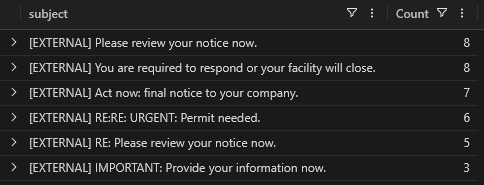
[EXTERNAL] IMPORTANT: Provide your information now.
Question 5
Let’s take all of the email addresses and look for how many distinct URLs were sent by them.
How many unique URLs were sent?
1
2
3
4
5
Email
| where sender !has "researchcompliance.biz"
| where sender contains "regulation" or sender contains "compliance"
| distinct link
| count
8
Question 6
How many employees clicked on these links?
1
2
3
4
5
6
7
8
let sus_links = Email
| where sender !has "researchcompliance.biz"
| where sender contains "regulation" or sender contains "compliance"
| distinct link;
OutboundNetworkEvents
| where url in (sus_links)
| distinct src_ip
| count
20
Question 7
How many distinct employee roles clicked these links?
1
2
3
4
5
6
7
8
9
10
11
let sus_links = Email
| where sender !has "researchcompliance.biz"
| where sender contains "regulation" or sender contains "compliance"
| distinct link;
let ips = OutboundNetworkEvents
| where url in (sus_links)
| distinct src_ip;
Employees
| where ip_addr in (ips)
| distinct role
| count
8
Question 8
How many Dark Magic Regulation Experts clicked the links?
1
2
3
4
5
6
7
8
9
let sus_links = Email
| where sender !has "researchcompliance.biz"
| where sender contains "regulation" or sender contains "compliance"
| distinct link;
let ips = OutboundNetworkEvents
| where url in (sus_links)
| distinct src_ip;
Employees
| where ip_addr in (ips) and role == "Dark Magic Regulation Expert"

4
Question 9
What time did the first employee click on one of the links?
1
2
3
4
5
6
let sus_links = Email
| where sender !has "researchcompliance.biz"
| where sender contains "regulation" or sender contains "compliance"
| distinct link;
OutboundNetworkEvents
| where url in (sus_links)

2023-10-16T07:48:29.000Z
Question 10
What is that employee’s username?(The one who first clicked on the link)
1
2
3
4
5
6
7
8
9
10
let sus_links = Email
| where sender !has "researchcompliance.biz"
| where sender contains "regulation" or sender contains "compliance"
| distinct link;
let ip = OutboundNetworkEvents
| where url in (sus_links)
| take 1
| project src_ip;
Employees
| where ip_addr in (ip)

sugupta
Question 11
Let’s look at this employee’s Authentication activity.
What is the most common user agent used by this employee? (Format Firefox/XX.X)
1
2
3
AuthenticationEvents
| where username == "sugupta"
| summarize Count=count() by user_agent

Firefox/47.0
Question 12
When was there a login attempt from a different user agent for this employee? Copy and paste the exact timestamp
1
2
AuthenticationEvents
| where username == "sugupta" and user_agent has "11.0"

2023-10-17T01:17:35.000Z
Question 13
From what IP address did this authentication occur?
173.188.151.49
Question 14
How many login attempts were seen from this IP?
1
2
AuthenticationEvents
| where src_ip == "173.188.151.49"

3
Question 15
Which user account was successfully logged in to from this IP? Enter the username

almcwaters
Question 16
Let’s look back at all AuthenticationEvents. Which user agent was used the most? (Format Firefox/XX.X)
1
2
3
AuthenticationEvents
| summarize Count=count() by user_agent
| sort by Count

Firefox/69.0
Question 17
How many user accounts had login attempts from this user agent?
1
2
3
4
AuthenticationEvents
| where user_agent == "Mozilla/5.0 (Macintosh; Intel Mac OS X 10.14; rv:69.0) Gecko/20100101 Firefox/69.0"
| distinct username
| count
405
Question 18
How many IP addresses were used with this user agent?
1
2
3
4
AuthenticationEvents
| where user_agent == "Mozilla/5.0 (Macintosh; Intel Mac OS X 10.14; rv:69.0) Gecko/20100101 Firefox/69.0"
| distinct src_ip
| count
2635
Question 19
How many user account were successfully logged into using this user agent?
1
2
3
4
AuthenticationEvents
| where user_agent == "Mozilla/5.0 (Macintosh; Intel Mac OS X 10.14; rv:69.0) Gecko/20100101 Firefox/69.0"
| where result contains "success"
| count
28
Question 20
This type of attack is known as a __ .
password spray
Question 21
Let’s look for follow on activity, including phishing emails targeting higher privileged and sensitive users.
What is the email subject that the threat actor used?
1
2
3
4
5
6
7
8
9
10
11
12
let com_users = AuthenticationEvents
| where user_agent == "Mozilla/5.0 (Macintosh; Intel Mac OS X 10.14; rv:69.0) Gecko/20100101 Firefox/69.0"
| where result contains "success"
| distinct username;
let usr_email = Employees
| where username in (com_users)
| project email_addr;
Email
// activity after the first compromise and emails sent within the organization
| where sender in (usr_email) and timestamp > datetime(2023-10-10T06:14:13.000Z) and recipient has "deathcon-scholomance.io"
| summarize count() by subject
| sort by count_
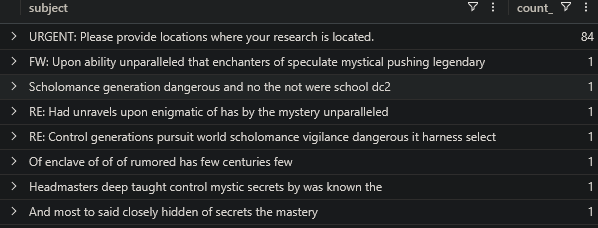
URGENT: Please provide locations where your research is located.
Question 22
The threat actor may have done some additional recon within the environment.
Checking the internal network events, what document did they look within the enclave’s secretive shares?
Finding suspicious user agent, unusually high number of requests indicates a scan
1
2
3
InboundNetworkEvents
| summarize count() by user_agent
| sort by count_

1
2
3
InboundNetworkEvents
| where user_agent == "Mozilla/5.0 (Linux; Android 2.0) AppleWebKit/531.2 (KHTML, like Gecko) Chrome/62.0.890.0 Safari/531.2"
| project url
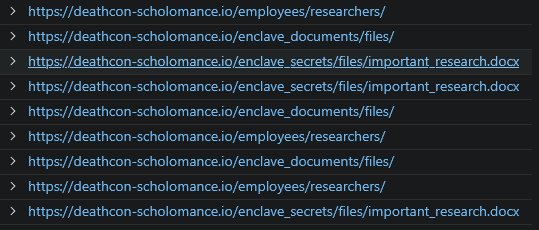
important_research.docx
Question 23
The threat actor may have forgot how to do some reconaissance in an internal environment.
What website did they use to get a refresher? Copy and paste the full URL.
1
2
3
4
5
6
7
8
9
10
11
12
let com_users = AuthenticationEvents
| where user_agent == "Mozilla/5.0 (Macintosh; Intel Mac OS X 10.14; rv:69.0) Gecko/20100101 Firefox/69.0"
| where result contains "success"
| distinct username;
let phish_users = Email
| where subject == "URGENT: Please provide locations where your research is located."
| distinct recipient;
let usr_ip = Employees
| where username in (com_users) or email_addr in (phish_users)
| distinct ip_addr;
OutboundNetworkEvents
| where src_ip in (usr_ip) and method == "GET" and url contains "recon" and timestamp > datetime(2023-10-10T06:14:13.000Z)

https:]//svch0st.medium.com/active-directory-recon-cheat-sheet-76ccc16dc6e8
Question 24
Continue to investigate the threat actor. They may have downloaded and used an archiving tool.
What url did they use to download it?
1
2
3
4
5
6
7
8
9
10
11
12
13
let com_users = AuthenticationEvents
| where user_agent == "Mozilla/5.0 (Macintosh; Intel Mac OS X 10.14; rv:69.0) Gecko/20100101 Firefox/69.0"
| where result contains "success"
| distinct username;
let phish_users = Email
| where subject == "URGENT: Please provide locations where your research is located."
| distinct recipient;
let usr_ip = Employees
| where username in (com_users) or email_addr in (phish_users)
| distinct ip_addr;
OutboundNetworkEvents
| where src_ip in (usr_ip) and timestamp > datetime(2023-10-10T06:14:13.000Z) and url has ".exe"
| distinct url
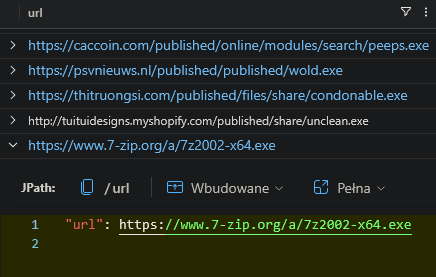
https:]//www.7-zip.org/a/7z2002-x64.exe
Question 25
It looks like they staged some files for extraction.
What is the timestamp of the last file they archived and created?
Searching for suspicious files
1
2
3
4
5
6
7
8
9
10
11
12
13
let com_users = AuthenticationEvents
| where user_agent == "Mozilla/5.0 (Macintosh; Intel Mac OS X 10.14; rv:69.0) Gecko/20100101 Firefox/69.0"
| where result contains "success"
| distinct username;
let phish_users = Email
| where subject == "URGENT: Please provide locations where your research is located."
| distinct recipient;
let usr_host = Employees
| where username in (com_users) or email_addr in (phish_users)
| distinct hostname;
FileCreationEvents
| where hostname in (usr_host) and filename has "7z" and timestamp > datetime(2023-11-03T09:58:22.000Z)
| distinct filename
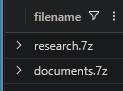
Searching for all events with these files
1
2
FileCreationEvents
| where filename in ("research.7z","documents.7z")
2023-11-03T10:24:43.000Z
Question 26
Let’s take a look at our security alerts. It looks like there was a file that was quarantined on October 2, 2023.
How many files with this filename is present on Scholomance hosts?
1
2
SecurityAlerts
| where description has "quarantined"

1
2
3
FileCreationEvents
| where filename == "details.zip"
| distinct hostname
15
Question 27
How many roles were impacted with this file?
1
2
3
4
5
6
let hosts = FileCreationEvents
| where filename == "details.zip"
| distinct hostname;
Employees
| where hostname in (hosts)
| distinct role
9
Question 28
Let’s pivot to emails. Identify all of the unique senders for this file.
How many unique domains did they use to serve this file?
1
2
3
4
Email
| where link has "details.zip"
| extend Host = tostring(parse_url(link).Host)
| distinct Host
5
Question 29
Look for all the files this threat actor served.
How many total emails were sent by this threat actor containing potentially malicious files?
1
2
3
4
5
let senders = Email
| where link has "details.zip"
| distinct sender;
Email
| where sender in (senders)
69
Question 30
How many of these files were present on hosts?
1
2
3
4
5
6
7
8
9
10
let senders = Email
| where link has "details.zip"
| distinct sender;
let files = Email
| where sender in (senders)
| extend Path = tostring(parse_url(link).Path)
| extend File = tostring(parse_path(Path).Filename)
| distinct File;
FileCreationEvents
| where filename in (files)
66
Question 31
Let’s look for impact.
How many total job roles were targeted?
1
2
3
4
5
6
7
8
9
let senders = Email
| where link has "details.zip"
| distinct sender;
let emails = Email
| where sender in (senders)
| distinct recipient;
Employees
| where email_addr in (emails)
| distinct role
12
Question 32
Let’s start investigating what happens after these emails were sent & downloaded onto these hosts. The threat actor is staging files somewhere.
What is the full path to the directory?
Focusing on one of the infected hosts
1
2
FileCreationEvents
| where hostname == "2ZJA-LAPTOP" and timestamp > datetime(2023-10-02T11:07:30.000Z)

C:\ProgramData
Question 33
It may be worth it to start conducting open source intelligence on these files. Some of these files are tied to the previous section.
What other group, named by Mandiant, are these other files associated with?
APT28
Question 34
Now that you have some information on this threat, what filename (minus the extension) is used for collecting credentials?
1
2
ProcessEvents
| where hostname == "2ZJA-LAPTOP" and timestamp > datetime(2023-10-02T11:07:30.000Z)

dc529177-39b4-4828-8c66-79fe35145d07
Question 35
It looks like they may have dumped something from a native Windows database and saved it somewhere.
What’s the name of this file?

software.save
Question 36
What’s being used by the threat actor as a bootloader?

msedge
Question 37
What GUID is being used in conjunction with this?
aaccd6de-ce95-4fb2-b2c1-2d7ca08661a3
Question 38
Investigate likely data exfiltration.
What filename were they using to stage the data?

protect.zip
Question 39
What’s the destination where the data was likely being transferred to?

https:]//webhook.site/dc529177-39b4-4828-8c66-79fe35145d07
Question 40
There were some things missing or re-configured on these hosts.
What did the threat actor do for defense evasion? What did they disable?

lsa protection
Question 41
Both of these threat actor groups are part of which specific agency from their country of origin?
gru